Speech–language pathology


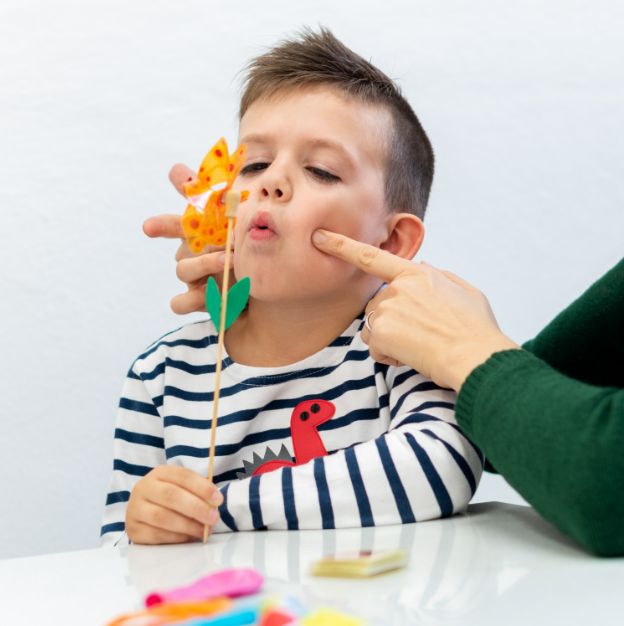
Speech–language pathology (SLPs) specializes in the evaluation, diagnosis, and treatment of communication disorders (speech and language impairments), cognitive-communication disorders, voice disorders, and swallowing disorders.
SLPs also play an important role in the diagnosis and treatment of autism spectrum disorder (often in a team with pediatricians and psychologists). Approximately 10% of children struggle with a communication disorder.
Children who receive speech-language therapy prior to the age of 5 years old have a much higher rate of success than those who begin intervention later. SLPs collaborate with other health care professionals, often working as part of a multidisciplinary team.
They can provide information and referrals to audiologists, physicians, dentists, nurses, nurse practitioners, occupational therapists, rehabilitation psychologists, dietitians, educators, behavior consultants (applied behavior analysis) and parents as dictated by the individual client’s needs. Research has indicated that children who receive early language intervention are less likely to develop compensatory error patterns later in life.

Learn More & Get Started
Our experts are eager to cater to your requirements and are available to address your inquiries through phone, email, or face-to-face meetings, should that be your preference. Rest assured, you will always be in the capable hands of one of our professionals.
Signs your child may benefit from speech therapy
- Few or no words by 18–24 months, or a vocabulary that has stopped growing
- Family members understand your child but strangers do not
- Difficulty putting words together into phrases or sentences
- Trouble following simple directions or answering questions
- Stuttering, or a voice that sounds hoarse or unusual
- Repeating phrases from videos instead of using language to communicate
- Frustration, tantrums or withdrawal because he cannot get his message across
- Difficulty with chewing, swallowing or a very restricted diet
If your child is not yet speaking, that does not mean therapy has to wait. Communication starts long before words — with eye contact, gestures, pointing and turn-taking — and those are all things we can build.
What our speech-language pathologists work on
- Expressive language — using words, phrases and sentences to say what he wants and thinks
- Receptive language — understanding words, questions and instructions
- Articulation and clarity — producing sounds so others can understand
- Social communication — greetings, conversation, reading facial expressions and body language
- Augmentative and alternative communication (AAC) — picture systems, signs or speech-generating devices for children who need another way to be heard
- Fluency and voice
- Feeding and swallowing — safety, texture tolerance and mealtime routines
Speech therapy and autism
Communication difficulties are one of the core features of autism, and they are often the first thing a parent notices. Speech therapy for an autistic child is not only about pronunciation: it is about giving your child a reliable way to be understood, whatever form that takes. When speech therapy and ABA run together, the therapist and the behavior analyst share goals, so your child practices the same communication skills in both settings instead of learning two separate systems.
Frequently asked questions
Is my child too young for speech therapy?
Rarely. Early intervention is one of the strongest predictors of good outcomes, and we can work with very young children through play and caregiver coaching.
Will using pictures or a device stop my child from talking?
No. The evidence points the other way: giving a child a working way to communicate tends to increase, not decrease, spoken language, because communicating becomes rewarding.
Do I need a referral?
It depends on your insurance plan. Call (813) 655-8159 and we will check the requirements with you.
How long will therapy last?
That depends on the goals and your child. The therapist will review progress with you regularly and be honest about when it is time to change the plan or discharge.
Speech therapy in Brandon, Lakeland and Winter Haven
We provide speech and language therapy at our clinics in Brandon, Lakeland and Winter Haven, serving families across Hillsborough and Polk counties.
Related therapies
- Applied Behavior Analysis (ABA)
- Pediatric Occupational Therapy
- Pediatric Physical Therapy
- All therapies we offer
Get started
Call (813) 655-8159 or request a consultation and tell us what you are hearing at home. También disponible en español.
Coverage, hours and starting without a waitlist
We accept Simply Healthcare, TriCare, Humana, Sunshine Health, Sunshine Health CMS, Florida KidCare, Step Up For Students, Ambetter and Molina Healthcare for speech therapy, plus private pay. Children’s Medical Services members move from Sunshine Health to Molina Healthcare on October 1, 2026; we accept both, so treatment continues without a gap. The full list is on our insurance we accept page, and we run the benefits check for you before you commit to anything.
All three clinics — Brandon, Lakeland and Winter Haven — are open Monday to Saturday, 8:00 AM to 7:00 PM, and there is no waitlist. Call (813) 655-8159 during business hours and a real person will answer; we are a family working for families, and this October we complete five years of doing it.
Do I have to wait months to start speech therapy?
No. Hopeful Therapies does not keep a waitlist. Once benefits are verified and the plan authorizes the assessment, we schedule you — typically within days.
Can my child receive more than one therapy at the same time?
Yes, and it is usually the better choice. ABA, speech-language, occupational and physical therapy are delivered by one coordinated team sharing a single treatment plan, which is the fastest path to reaching therapeutic goals.
A credentialed, coordinated team
Your child’s therapists work alongside our Board Certified Behavior Analysts, so ABA, speech, occupational and physical therapy goals reinforce each other instead of competing. Combining all of the therapies a child needs under one roof is the main reason our families reach their therapeutic goals faster. See our leadership and clinical team.